
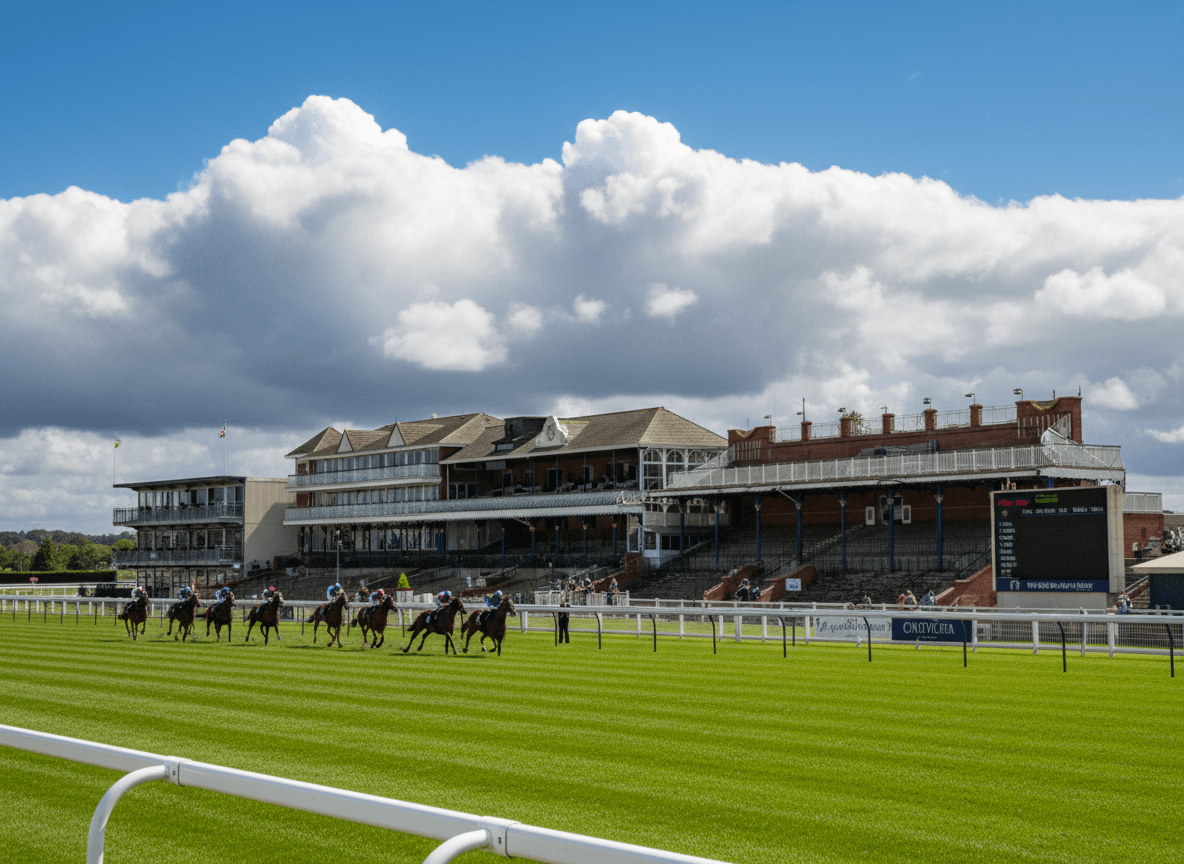
A Card Rebuilt: The Story Before A Runner Is Named
There is something quietly revealing about a race meeting that reaches the public eye before a single runner has been declared. The six-race evening card at Ayr on Saturday 15 August 2026 carries that particular quality — a programme that exists in outline only, its fields not yet populated, its market prices unformed. The meeting was originally abandoned and has since been reprogrammed with BHA Inspector support, the 72-hour-plus turnaround placing it firmly in the category of cards where conditions, declarations, and pace scenarios must all be reassessed from scratch.
It is, in a sense, a blank canvas. And blank canvases, for those who approach them with patience and method rather than noise, tend to reward the careful eye more generously than a conventional Saturday card where the narrative has already been written by the market.
What we can do now — usefully, meaningfully — is understand the architecture of the card, the nature of the track, and the conditions that will shape everything once declarations arrive. That groundwork rarely goes to waste.
Going Conditions: The Reprogram Variable
The abandonment itself is the first piece of evidence. BHA Inspector involvement over a 72-hour-plus window suggests the original going was either unsafe or sufficiently borderline to warrant the intervention. At Ayr in mid-August, that most commonly points to waterlogging following persistent summer rainfall — though equally, a course management issue following an unusually dry spell can produce surface irregularities that pass unnoticed until an inspector walks the track.
By the time this card runs, the going will almost certainly have shifted. Whether it settles into Good, Good to Firm, or carries residual softness from whatever prompted the original call will be the single most important variable for punters to monitor. Ayr's straight five-furlong course and its round mile are both sensitive to going changes — the camber on the home turn amplifies the disadvantage for horses that struggle in give underfoot, while the long run-in rewards those with a low, economical action on faster ground.
Check the Ayr racecard as declarations and going updates are confirmed — the BHA Inspector's final report will be the most important document on the card before a price is quoted.
The Card in Structure: Six Races, Six Stories to Be Written
The programme spans a pleasing variety of distances and age groups, even if the prize money sits firmly at the workmanlike end of the Flat calendar. The feature race by prize money is the Sky Sports Racing 415 Handicap Stakes (Class 5, 5f 10y, £8,400) for three-year-olds at 18:46, which edges out three other Class 5 contests by the slimmest of margins. Alongside it, the EBF Restricted Maiden Stakes at 18:16 carries its own significance as a GBB Race and EBF Qualifier — these two-year-old maiden contests over 5f 160y frequently surface horses that go on to considerably better things, and the restricted Band C/D entry condition tends to produce competitive, evenly-matched fields that repay close form study.
The stayers among the card's constituents will find their moment in the Bath Racecourse Handicap Stakes (1m 5f 11y) at 17:46, which opens the evening and doubles as a Bath Summer Stayers' Series Qualifier — a cross-course series that occasionally throws up lightly-raced improvers who have been placed with this exact type of opportunity in mind. Trainers who understand the qualifier structure tend to arrive here with purpose.
- 17:46 — Bath Racecourse Handicap Stakes (Class 6, 1m 5f 11y) — Stayers' Series Qualifier
- 18:16 — EBF Restricted Maiden Stakes (Class 5, 5f 160y) — Two-year-olds, GBB Race
- 18:46 — Sky Sports Racing 415 Handicap Stakes (Class 5, 5f 10y) — Three-year-olds
- 19:16 — gambling.com Handicap Stakes (Class 5, 5f 160y) — Three-year-olds and older
- 19:46 — Compare Betting Sites Handicap Stakes (Class 6, 1m 2f 37y) — Four-year-olds and older
- 20:16 — Bath Handicap Stakes (Class 6, 1m) — Three-year-olds and older
Course Characteristics: What Ayr Asks of Its Runners
Ayr is one of the finest Flat tracks in Britain — a left-handed, galloping circuit that places a premium on stamina and straightforward jumping ability in equal measure. The straight course, used for the sprint contests on this card, runs into a slight headwind more often than not in the evening sessions, which can compress finishing times and occasionally flatter hold-up horses who find cover in the early stages. Draw bias on the straight at Ayr is a perennial discussion: in large fields, particularly on going with any cut in it, low draws have historically held an advantage in the first furlong before the field fans out. On faster ground, the bias tends to flatten considerably.
The round course, which comes into play for the mile, the mile-and-a-quarter, and the mile-and-five contests, has a long sweeping bend that rewards horses who travel smoothly into their races. Front-runners on the round course at Ayr are not automatically at a disadvantage — the track does not punish pace the way some tighter circuits do — but genuine stayers who can be covered up before the home turn tend to find the two-furlong run-in long enough to make their move count.
For the sprint fields, particularly the two Class 5 five-furlong contests, course and distance form will carry genuine weight once declarations land. Horses with a [C] or [D] marker at this track in this trip range should be elevated in any initial assessment, regardless of market position.
Ones to Watch: A Framework for When Runners Are Declared
With no runners yet declared, specific selections are premature — and any journalist who offers you confident tips from an empty racecard is selling you something other than analysis. What can be offered, honestly and usefully, is a framework.
In the EBF Restricted Maiden (18:16), look for any two-year-old with a previous run over course and distance, or one with a pedigree that suggests the combination of five furlongs and an Ayr surface will bring improvement. Sires with strong Scottish Flat records — those whose offspring tend to handle the particular blend of pace and stamina the track demands — are worth a note.
In the feature sprint handicap (18:46), the three-year-old market will likely be shaped by exposed form and official ratings. Horses on a downward trajectory in the weights, or those returning from a break with a freshness angle, tend to find their level in Class 5 sprint handicaps at this time of year. Any runner with a course win on their record should be treated with respect regardless of recent form.
In the stayers' qualifier (17:46), trainer intent matters enormously. A horse entered specifically for the Bath Summer Stayers' Series by a handler who has used the qualifier structure before is not here by accident.
Return to the Ayr racecard once declarations are confirmed — that is where the real work begins.
Summary: Patience is the First Bet
A reprogrammed card at Ayr with no runners yet declared is, paradoxically, one of the more interesting starting points of the summer. The disruption creates information asymmetry — those who track going updates closely, who understand the track's characteristics, and who respond quickly to the declaration sheet will hold an edge over those who wait for the market to do their thinking for them.
The going report, when it arrives, will be the card's defining document. The draw in the sprint fields will be its most granular variable. And the trainer intentions behind the qualifier entries — particularly in the stayers' race — will tell a quieter story that the market may be slow to price.
Check back for a full runner-by-runner update once declarations are confirmed. The framework above is designed to travel — apply it to whatever fields emerge, and the card should make sense.


