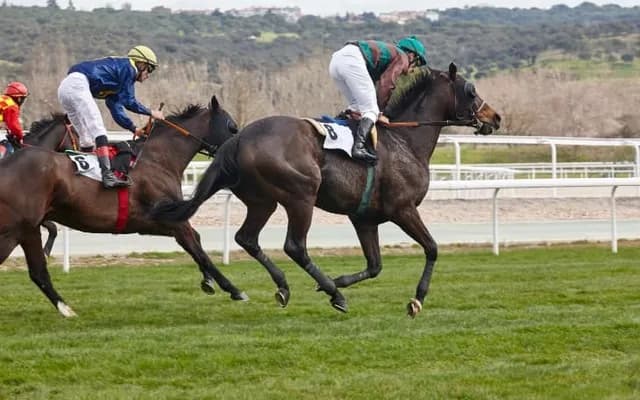
Royal Ascot is five days of Flat racing in mid-June at Ascot in Berkshire, run from Tuesday to Saturday. Ascot describes it as Britain's most valuable race meeting. In recent years the programme has had 35 races, seven a day, including eight Group 1s. This guide covers the meeting, the big races, the handicaps and the betting principles that apply every year.
What Royal Ascot is
Ascot itself dates from 1711. That year Queen Anne, out riding from Windsor Castle, picked out a stretch of heath at East Cote as a place for horses to gallop at full stretch. The first race, Her Majesty's Plate, was run that August in three four-mile heats, with every runner carrying 12st.
The Royal Meeting as we know it started to take shape with the first Gold Cup in 1807, which is still the oldest race on the course. In 1822 King George IV commissioned a stand with a lawn around it, open only to people he invited. That became the Royal Enclosure. In 1825 he started the Royal Procession, leading a line of carriages up the Straight Mile.
The racecourse is on Crown Estate land, and the monarch has always appointed someone to run it on the Crown's behalf. In 1913 an Act of Parliament set up the Ascot Authority and moved the day-to-day running of the course out of the Royal Household.
For most of its history the meeting lasted four days. A Saturday was added in 2002 for Queen Elizabeth II's Golden Jubilee, and the meeting has run over five days ever since. Two recent years were exceptions. In 2005 the meeting moved to York while Ascot's grandstand was rebuilt, and in 2020 it was run behind closed doors during the pandemic.
The royal connection today
Each afternoon starts with the Royal Procession. The King, the Queen and their guests drive down the track in horse-drawn landaus before the first race. Queen Elizabeth II never missed a Royal Meeting from her accession until the pandemic, and she owned 24 Royal Ascot winners. One of them, Estimate, won the 2013 Gold Cup, the first time a reigning monarch had won the race.
Its place in the season
Royal Ascot comes a few weeks after the Guineas meetings and Epsom, so it is the first big test of the spring Classic form. The St James's Palace Stakes and Coronation Stakes regularly bring together the season's best three-year-old milers. The Ribblesdale is often the next target for fillies beaten in the Oaks. The two-year-olds also get their first big tests of the week in the Coventry Stakes and the Queen Mary Stakes.
The Group 1 races, day by day
Ascot publishes the full programme each spring and the order of the supporting races sometimes changes. The days below are the ones the eight Group 1s have been run on in recent years:
| Day | Group 1 | Distance | Open to |
|---|---|---|---|
| Tuesday | Queen Anne Stakes | 1m (straight) | Four-year-olds and up |
| Tuesday | King Charles III Stakes | 5f | Sprinters |
| Tuesday | St James's Palace Stakes | 1m (round) | Three-year-olds |
| Wednesday | Prince of Wales's Stakes | 1m2f | Four-year-olds and up |
| Thursday | Gold Cup | About 2m4f | Stayers |
| Friday | Commonwealth Cup | 6f | Three-year-old colts and fillies |
| Friday | Coronation Stakes | 1m | Three-year-old fillies |
| Saturday | Queen Elizabeth II Jubilee Stakes | 6f | Four-year-olds and up |
Tuesday: Queen Anne, King Charles III and St James's Palace
The Queen Anne Stakes opens the meeting and is named after Ascot's founder. It is a straight-mile Group 1 for older horses. Frankel won it in 2012, and in 2016 the American mare Tepin became one of the meeting's landmark overseas winners.
The King Charles III Stakes is the first Group 1 sprint of the week, over five furlongs. Until 2023 it was the King's Stand Stakes. It was first run under its current name in 2024 and was renamed in recognition of the King's support for racing. Older form guides and statistics will list it under the old name.
The St James's Palace Stakes is for three-year-olds over the round mile. It often brings together the best milers of the Classic generation, so it is usually the first real test of the spring Guineas form.
Wednesday: Prince of Wales's Stakes
The Prince of Wales's Stakes is the middle-distance highlight of the week, a mile and a quarter for horses aged four and up.
Thursday: the Gold Cup
The Gold Cup is run over about two and a half miles and is the oldest race at the meeting. Thursday is known as Ladies' Day, a name that seems to date back to 1823. The winning owner keeps the gold trophy.
The race's history is built around a few great stayers. Yeats won four in a row from 2006 to 2009, which no horse had done before, and Ascot has a statue of him by the parade ring. Lester Piggott won eleven Gold Cups. The Racing Post calls the trip an extreme test of stamina, so proven stamina is the first thing to look for.
Friday: Commonwealth Cup and Coronation Stakes
The Commonwealth Cup was added in 2015. Ascot created it to fill a gap in the European programme and crown a champion three-year-old sprinter. It is run over six furlongs and restricted to three-year-old colts and fillies.
The Coronation Stakes is the mile championship for three-year-old fillies. Guineas form is the usual route in. According to the Racing Post, ten of the twelve winners up to 2025 ran in a 1,000 Guineas on their previous start.
Saturday: Queen Elizabeth II Jubilee Stakes
The Queen Elizabeth II Jubilee Stakes is a six-furlong Group 1 for horses aged four and up. It has been renamed more than once. It was the Diamond Jubilee Stakes when Black Caviar won in 2012 and the Platinum Jubilee Stakes in 2022. After Queen Elizabeth II died, it was renamed in her memory from 2023. Ascot chose this race because, along with the Gold Cup, it was the one she traditionally presented the trophy for.
Australia's Black Caviar won the race in 2012, then as the Diamond Jubilee, by the narrowest of margins after her jockey eased her near the line. In 2019 Blue Point won the King's Stand and Diamond Jubilee in the same week, the first horse to do the double since Choisir in 2003.
The big-field handicaps
For many punters the Group 1s are the spectacle and the handicaps are where the betting is. The best known are the heritage handicaps. The days shown are the ones they have been run on in recent years:
- Royal Hunt Cup (Wednesday): a mile handicap on the straight course. It can have up to 30 runners.
- Britannia Stakes (Thursday): a mile handicap for three-year-old colts and geldings.
- Wokingham Stakes (Saturday): a six-furlong handicap for three-year-olds and up, and the oldest handicap at the meeting.
Other handicaps include the Ascot Stakes over two and a half miles on the opening day, the King George V Stakes for three-year-olds over a mile and a half, and the Buckingham Palace Stakes over seven furlongs.
Why they are so hard to solve
Several things make these races hard to call:
- Field size. With up to 30 runners, a horse can easily be blocked or left on the wrong side even if it is well handicapped.
- Targeted horses. Trainers often plan a whole season around one of these races. That means plenty of runners are near their best on the day and hard to separate on the ratings.
- Unexposed three-year-olds. In the Britannia and the King George V, many runners have had only a handful of races. Their handicap marks may not yet show how good they are. Our guide to progressive handicap betting covers how to spot improvers.
- The draw and the split. On the straight course, big fields often split into two or more groups, so where a horse is drawn decides which group it races in.
International runners
Royal Ascot is a target for trainers from around the world, and Irish stables are always well represented, above all Aidan O'Brien's at Ballydoyle. O'Brien's first Royal Ascot winner was Harbour Master in the 1997 Coventry Stakes, and he reached 100 winners at the meeting in 2024.
American trainer Wesley Ward has made a speciality of the juvenile sprints. In 2016 his filly Lady Aurelia won the Queen Mary, and the same year Tepin won the Queen Anne. Lady Aurelia came back to win the King's Stand in 2017, the first American-trained horse to win twice at the meeting.
Australian sprinters have a good record too. Black Caviar won the Diamond Jubilee in 2012, Nature Strip won the King's Stand in 2022, and Asfoora won the first running of the King Charles III Stakes in 2024. Runners from Japan took part in 2022 as well.
For punters, the difficulty is rating overseas form against European form. A horse coming off a different racing programme and different ground can be hard to price, so form from other countries needs extra care before it is trusted.
Betting angles that apply every year
Draw and track bias on the straight course
Ascot's straight course is a mile long. It hosts the sprints, the Queen Anne and big mile handicaps such as the Royal Hunt Cup. When a big field splits into groups, the side that turns out to be faster can matter more than the form book. Which side is faster is not fixed.
The bias can change from day to day and even within a day. Ground, rain, watering and where the pace horses are drawn all play a part. In 2017 two trainers complained to the Racing Post that watering during the week had left the far side quicker. The clerk of the course said he did not think there had been a big bias. In a 2023 Royal Hunt Cup preview, Sporting Life noted that the stands' rail was riding faster after rain that morning, and that most of the early pace was drawn high.
Avoid any claim that one side always wins at Ascot. Two habits are more useful:
- Watch the earlier races on the straight course that day. Note which group finished in front, and whether that was down to the ground or to the pace.
- Check where the front-runners are drawn. A group with no early pace can be left behind whatever the ground.
For more on reading a race this way, see our guides to using track bias and pace analysis.
Each-way terms and extra places
Standard each-way terms in a handicap with 16 or more runners pay a quarter of the odds for the first four places. In non-handicaps with eight or more runners, they pay a fifth of the odds for the first three. Large fields make the big handicaps natural each-way races. Bookmakers sometimes offer more places than standard, and when they do, the place part of the bet can be worth more than usual.
Extra places can come with slightly lower place odds or a shorter win price. Compare the terms rather than assuming more places always means better value. To work out what a bet returns, see how to calculate betting odds and payouts.
Ante-post betting and non-runner no bet
Markets on the Group 1s open months in advance, and the prices can be much bigger than on the day. The risk is that your horse goes for a different race or does not run at all. With a normal ante-post bet, that stake is lost.
That is why a non-runner no bet (NRNB) market is valuable. If your horse does not run, you get your stake back. Bookmakers often switch to NRNB only in the last week or so before a race, and the terms vary between firms. Our guides to non-runner no bet and ante-post betting explain the details.
The Placepot
Big fields, two-year-old races and heritage handicaps make Royal Ascot Placepots hard to land. Our Placepot guide covers how to build a permutation without overspending.
Best Horse Racing Betting Sites


Visiting Royal Ascot
There are four enclosures. Three of them are sold to the public: the Windsor, the Village and the Queen Anne.
- Royal Enclosure. Members and their guests only. New members must be sponsored by two existing members, and applications are approved by His Majesty's Representative at Ascot. Gentlemen wear morning dress and a top hat.
- Queen Anne Enclosure. Ascot's premier public enclosure. Gentlemen wear a suit and tie, and ladies wear a hat, headpiece or fascinator.
- Village Enclosure. Set in the middle of the track, with a festival atmosphere. In recent years it has opened from Thursday to Saturday only.
- Windsor Enclosure. The cheapest ticket, with no formal dress code. It does not include access to the Grandstand or parade ring.
The dress code is enforced at the gate and the details are revised from time to time. Check the current rules on Ascot's website before you travel.
Frequently asked questions
When is Royal Ascot held?
Royal Ascot runs for five days, Tuesday to Saturday, in mid-June. Ascot confirms each year's dates well in advance, and you can find them on the racecourse's website.
How many Group 1 races are run at Royal Ascot?
Eight, as the meeting is currently set up. Three are on Tuesday: the Queen Anne, King Charles III and St James's Palace Stakes. Wednesday has the Prince of Wales's Stakes, Thursday the Gold Cup, and Friday the Commonwealth Cup and Coronation Stakes. Saturday closes with the Queen Elizabeth II Jubilee Stakes.
What is the oldest race at Royal Ascot?
The Gold Cup, first run in 1807, is Ascot's oldest surviving race. Among the handicaps, the Wokingham Stakes is the oldest.
What was the King's Stand Stakes renamed?
The five-furlong Group 1 on the opening day is now the King Charles III Stakes, and was first run under that name in 2024. The Saturday six-furlong Group 1, formerly the Diamond Jubilee and then the Platinum Jubilee Stakes, has been the Queen Elizabeth II Jubilee Stakes since 2023.
Is there a draw bias at Royal Ascot?
There can be, but it is not fixed. In big fields on the straight course, one group often does better than the other. Which side is favoured depends on the ground, watering and where the pace is, and it can change during the week. Judge it from how the earlier straight-course races were run that day.
Who is the most successful jockey in Royal Ascot history?
Lester Piggott rode 116 winners at the meeting between 1952 and 1993, a record no one has come close to. Frankie Dettori retired from the meeting in 2023 with 81 winners.
Which horse has won the Gold Cup the most times?
Yeats won four Gold Cups in a row from 2006 to 2009, which no horse had done before. At the meeting overall, Brown Jack won seven years in a row in the 1920s and 1930s: the 1928 Ascot Stakes, then the Queen Alexandra Stakes six years running from 1929 to 1934.
What is the Royal Procession?
Each afternoon before racing, the King, the Queen and their guests are driven down the course in horse-drawn landaus. The tradition goes back to 1825, when King George IV led four other carriages up the Straight Mile.
Please gamble responsibly. You must be 18 or over to bet. For advice and support, see our responsible gambling page.