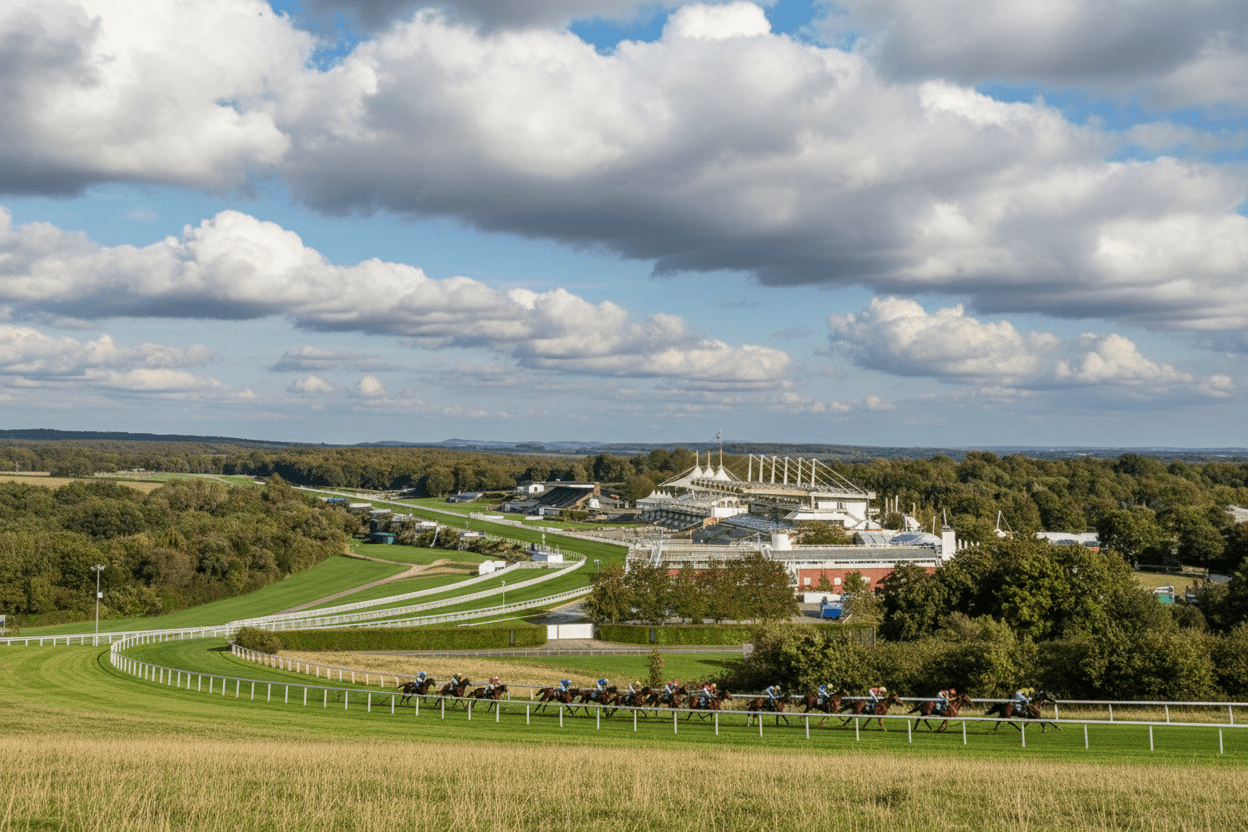

A Course Built on Something Deeper
There is something quietly remarkable about Ffos Las that no amount of marketing copy can quite capture. Stand in the grandstand on a grey Welsh afternoon, the Carmarthenshire hills folding softly into the distance, and you sense it — this is a place that was made from something else entirely. Beneath the manicured turf and the well-maintained hurdles lies the ghost of an open-cast coal mine, a landscape reclaimed and reimagined into one of British racing's more unlikely success stories.
When Ffos Las opened in 2009, it carried the distinction of being the first new National Hunt course to open in Britain for eighty years. That alone would be enough to earn it a footnote in racing history. But what has given it genuine staying power is the quality of the racing it produces — fair, honest, and consistently competitive. The track's left-handed galloping oval, measuring approximately a mile and four furlongs per circuit, rewards genuine ability rather than course craft. The long, four-furlong home straight is a particular feature: there is nowhere to hide here, and horses that win at Ffos Las tend to win on merit.
It is, in the truest sense, a course that suits honest horses and patient punters. And this week, it offers both codes across three separate fixtures — each with its own character, its own going, and its own set of puzzles to solve.
The Week Ahead: Three Fixtures in Focus
Monday, 21 September — Flat, Afternoon (Heavy, Soft in Places)
The week opens with a Flat card on Monday that will test stamina as much as class. With the going reported as Heavy, Soft in Places and a soil moisture reading of 62, conditions are demanding by any measure. Eight races are scheduled for the afternoon, and the ground will be the dominant factor in almost every one of them.
Heavy ground at Ffos Las is not uncommon in the autumn, and the course's renowned drainage — one of the genuine engineering achievements of this modern venue — helps to keep the surface consistent even when waterlogged. That said, a reading of 62 on the soil moisture monitor is significant. Trainers who have declared runners here will have done so with purpose; this is not a track where connections send horses speculatively into the mud. Check the Ffos Las Monday racecard carefully for any last-minute withdrawals, and pay close attention to horses whose form figures include an 'H' in the going column — proven mudlarks will have a considerable edge.
Tuesday, 22 September — Jump, Afternoon (Good, Easy Side of Good)
Tuesday brings a welcome change of code and conditions. Six races over jumps on Good, Easy Side of Good ground — a soil moisture reading of 46 — represents close to ideal for National Hunt racing at this time of year. The surface will be quick enough to favour athletic, fluent jumpers without being firm enough to trouble those with any physical fragility.
Ffos Las over jumps is a particular pleasure to study. The flat terrain and long home straight mean that jumping errors in the back straight can often be recovered before the line — but a mistake at the final fence or the last flight is usually fatal to winning chances. Horses that jump cleanly and travel sweetly through their races tend to dominate here. View the full Ffos Las Tuesday racecard for the complete race-by-race breakdown.
Sunday, 27 September — Flat, Afternoon (Going TBC)
The week closes with a seven-race Flat card on Sunday, though the going is yet to be confirmed at the time of writing. Given the trajectory of conditions through the week, it would be reasonable to anticipate something in the Soft to Good-to-Soft range — though a drying wind or further rainfall could alter that picture considerably. Keep an eye on the Ffos Las Sunday racecard as declarations and going updates emerge closer to the day.
Reading the Track: Draw, Pace, and Course Craft
For Flat racing at Ffos Las, the draw deserves careful consideration, particularly in sprint distances. The track's left-handed configuration and the nature of the home straight mean that low draws tend to hold a slight advantage in larger fields over shorter trips — horses drawn high can find themselves covering extra ground on the turn into the straight. In smaller fields, the effect is less pronounced, and pace becomes the more dominant variable.
Over middle distances, the long home straight rewards horses that can sustain their gallop. Front-runners who set honest fractions can be surprisingly difficult to peg back here, particularly in ground on the easy side. Conversely, when the pace is truly searching — as it may well be on Monday's heavy ground — hold-up horses with a genuine turn of foot can come into their own late in the day.
For the jumps card on Tuesday, pace scenarios are equally worth considering. Ffos Las tends to produce genuinely run races over hurdles and fences, and the flat nature of the circuit means that false dawdles are less common than at more undulating tracks. Horses that race prominently and jump fluently are your friends here.
The Type of Horse That Thrives at Ffos Las
Across both codes, there is a consistent profile of horse that does well at Ffos Las:
- Genuine stayers and mudlarks on the Flat — particularly relevant this Monday. Horses bred to stay and proven in soft conditions are the ones to side with when the soil moisture reading climbs above 55.
- Clean jumpers with a good cruising speed — for the Tuesday card, horses that travel smoothly and meet their fences right will have a significant advantage over those that rely on athleticism to compensate for jumping errors.
- Horses with previous course form — Ffos Las is consistent enough in its character that previous winners here should always be noted. The track does not flatter horses; if they won here before, they earned it.
- Welsh and West Country stables — trainers based in the region know this track intimately. Evan Williams, Christian Williams, and their contemporaries have a strong record here, and local knowledge counts for more than it sometimes gets credit for.
Practical Notes for Racegoers and Punters
If you are attending any of this week's fixtures, a few things are worth bearing in mind. Ffos Las is set in rural Carmarthenshire, and while it is well-signposted from the A484, allow extra time if travelling from further afield — the lanes approaching the course can back up on busier racedays. The facilities are modern and well-kept, and the grandstand offers a fine view of the home straight, which is where most races are truly decided.
For those betting from home, the key discipline this week is ground verification. The going on Monday is already testing, and any further rainfall before the card could push conditions beyond what some declared runners will handle. Check the official going reports on the morning of each fixture and cross-reference with trainer comments where available. A horse declared for heavy ground that has only ever run on good-to-firm is a horse to oppose, regardless of its rating.
On Tuesday's jumps card, the more benign conditions invite a slightly more straightforward approach — but do not neglect the importance of jumping ability. A horse with a clean jumping record at a track like this is worth a premium in your assessment, even if the form figures do not immediately shout.
A Welsh Week Worth Watching
Ffos Las does not demand your attention with noise or spectacle. It earns it quietly, race by race, with the kind of honest, well-run fixtures that remind you why the smaller venues are so often the most rewarding to follow. Three cards across two codes, a range of going conditions that will test horses in genuinely different ways, and a course whose character rewards those who take the time to understand it — this is a week that repays close attention.
Whether you are heading to Carmarthenshire in person or following the action from home, the Ffos Las course page has everything you need to prepare. Study the ground, respect the draw, and trust the horses that have been here before. The coal seams are long gone, but the racing that replaced them has real depth.