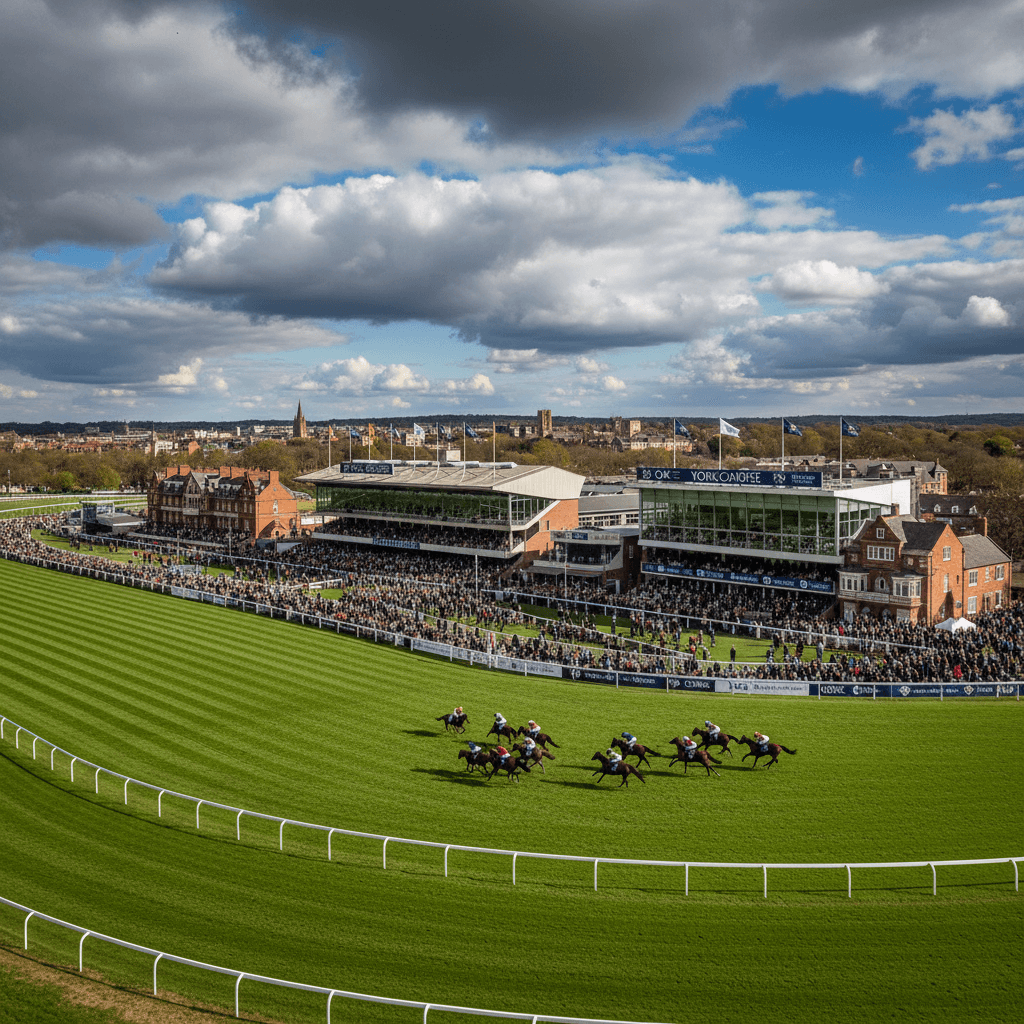
A Course That Earns Every Superlative
There are racecourses you visit, and then there are racecourses that stay with you. York belongs firmly in the second category. The Knavesmire — that great, sweeping expanse of North Yorkshire turf — has been hosting horse racing in one form or another since the Romans used this very ground, and the officially established course has been drawing crowds since the 1730s. Walk through the gates on a summer afternoon and you feel the weight of that history in the best possible way: not as something dusty or distant, but as something alive, something that gives meaning to every race run here.
What sets York apart from so many of its rivals is a rare combination of qualities. The track itself is genuinely fair — wide, galloping, left-handed, with a long, sweeping run-in that gives horses every opportunity to express themselves. The ground is consistently well-maintained. The facilities are outstanding. And the atmosphere, particularly on a warm July or August afternoon with the city's medieval skyline shimmering in the background, is simply unlike anywhere else in British flat racing. It is, in the most literal sense, a beautiful place to watch horses run.
This week brings us two opportunities to enjoy it, with fixtures on Tuesday, 28 July and Sunday, 2 August. We are edging towards the Ebor Festival — York's midsummer crescendo — and the racing on these two cards will carry that building sense of anticipation. Let's look at what to expect.
This Week's Fixtures at a Glance
Tuesday, 28 July 2026
Tuesday's afternoon card offers six races on Good to Firm ground — a going description that will delight connections of quick, athletic horses bred to travel across fast turf with minimum interference. Good to Firm at York in late July is about as good as it gets for a flat racing surface: consistent, true, and rewarding of genuine ability. There will be no excuses for beaten horses on this ground, which is exactly as it should be at a course of this calibre.
Six races across an afternoon session gives punters and racegoers a satisfying day without feeling overwhelming, and at York the spaces between races are never wasted — there is always something to look at, whether that is the horses in the paddock, the city views, or the general theatre of one of England's great sporting venues. You can find the full York Tuesday racecard here.
Sunday, 2 August 2026
Sunday's card is also six races, though the going is listed as TBC at the time of writing. Given the trajectory of the week's weather and the likelihood of continued dry conditions through late July, it would be reasonable to anticipate something similar to Tuesday — Good to Firm, or perhaps just Good if there is any overnight moisture. Keep an eye on the going updates in the days leading up to the meeting, as even a small shift in conditions at York can meaningfully alter the complexion of a race. The full York Sunday racecard will be updated as declarations are confirmed.
Reading the Knavesmire: Track Characteristics and Draw Biases
Understanding York's track is essential to betting here with any confidence, and the good news is that the course rewards careful study rather than punishing it. The oval, left-handed configuration features a long home straight — around four furlongs from the final bend to the winning post — which means that horses have genuine time to find their stride and fight out a proper finish. This is not a track where a horse can be bustled along in the closing stages and produce something from nowhere; class and stamina tend to be properly exposed here.
On sprint distances — the five and six-furlong races — draw has historically been a meaningful factor at York, with horses drawn towards the stands rail (higher stall numbers) often enjoying an advantage, particularly on fast ground when the pace is strong and the field fans wide. As distances increase, the draw becomes progressively less significant, and by a mile and beyond, it is largely irrelevant. Always check the draw statistics for the specific distance before committing to a selection.
Pace dynamics are equally important. York's long, flat home straight means that horses who race prominently without making the running are often well-positioned to pounce, while those who come from the back of the field need a truly strong gallop to be set up for them. In smaller fields on fast ground, the pace can be surprisingly moderate, which can catch out punters who back hold-up horses on autopilot.
What Type of Horse Thrives at York?
York is, above all else, a galloper's track — and that word matters. Horses who take a strong hold, who need to be restrained and then produced with a late burst, can find the track less forgiving than they might at a tighter, turning circuit. The horses who tend to shine here are those with a long, ground-covering stride: the types who travel smoothly through their races, maintain their rhythm around the gentle bends, and then simply sustain their effort all the way to the line.
- Stamina is rarely wasted at York. Even over a mile, the track's galloping nature means that a horse's ability to see out the trip is tested more rigorously than on many other flat courses.
- Horses with a high cruising speed — those who can travel comfortably in the first half of a race without burning energy — are ideally suited to the long home straight.
- Bigger, scopey individuals often take to the Knavesmire particularly well. The wide track and excellent surface give them room to stride out properly.
- Horses who handle fast ground are at a clear advantage this week, given the Good to Firm conditions on Tuesday. Soft-ground specialists are best left alone.
- Proven York form is worth a significant premium. Some horses simply love this place, and a horse that has run well here before — even in defeat — deserves extra respect when returning.
Practical Tips for Racegoers and Punters
If you are heading to the Knavesmire this week, a few practical thoughts. Arrive early enough to watch the horses in the paddock before each race — York's parade ring is excellent, and the pre-race inspection tells you a great deal about how a horse is feeling on the day. On Good to Firm ground, you want to see horses moving fluidly and confidently, not those who look stiff or reluctant on the firm surface underfoot.
For those betting from home, resist the temptation to dismiss the going update as a formality. York's groundstaff are meticulous, and their going reports are reliable — trust them. If the Sunday going shifts from Good to Firm to Good, revisit any selections you have made on the basis of fast-ground form.
Finally, pay attention to the trainers. York attracts the best yards in the country, and certain handlers have outstanding records here. Trainers who prioritise horse welfare and take the time to prepare their horses properly for big, galloping tracks tend to do well on the Knavesmire — the course rewards care, and that is not a coincidence.
A Week Worth Savouring
We are in the heart of the flat racing summer, and two fixtures at York this week feel like a genuine gift. Tuesday's Good to Firm card promises the kind of racing the Knavesmire does best — honest, open, and decided by merit — while Sunday offers the prospect of another fine afternoon as we edge closer to the Ebor Festival and the season's most celebrated days. Whether you are going racing, betting from the sofa, or simply following the results, York has a way of making every race feel like it matters. That, perhaps more than anything else, is what makes it so special.